Artificial intelligence (AI) is rapidly changing the way societies communicate, make decisions, provide services and respond to crises. For refugees and migrants, people who may already be exposed to conflict, displacement, discrimination, poverty and other forms of vulnerability, the implications of this technological transformation are particularly significant.
AI can help humanitarian organisations anticipate crises, improve access to information, identify vulnerable populations and deliver assistance more efficiently. At the same time, the technology can also deepen surveillance, discrimination, exclusion and the violation of privacy when it is developed or deployed without sufficient ethical safeguards.
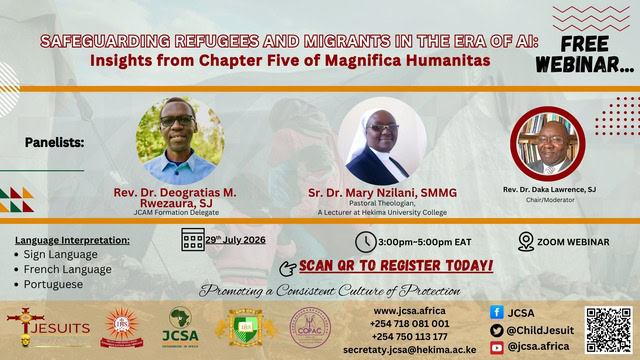
These tensions were at the heart of the webinar, “Safeguarding Refugees and Migrants in the Era of AI,” organised as part of ongoing conversations on safeguarding, human dignity and vulnerability.
The discussion brought together Fr. Deogratias, SJ; Sister Mary; and Mr. George, who examined the relationship between artificial intelligence, migration, safeguarding and human dignity. A central question emerged throughout the conversation: Will humanity use AI to strengthen a culture of power, or can it become an instrument for building a civilization of love?
Refugees and migrants are first and foremost human beings
The conversation began by clarifying an important distinction between refugees and migrants.
Fr. Deogratias, SJ, explained that the term refugee has a specific meaning under international protection frameworks, while “migrant” is a broader term covering people who move across borders or within a country for different reasons and under different circumstances.
But beyond legal and technical definitions lies a more fundamental reality: these are people whose dignity and rights must be respected.
As Fr. Deogratias emphasised:
“Protection is key for any person and we will delve into that now.”
This principle provides an important foundation for considering the impact of AI. Technology should not cause displaced people to be reduced to numbers, biometric records, risk scores or data points. Behind every record is a human being with a history, relationships, aspirations, fears and rights.
Safeguarding therefore requires more than preventing immediate physical harm. It also involves protecting dignity, privacy, participation, wellbeing and the ability of people to make decisions about their own lives.
AI presents both an opportunity and a risk
Artificial intelligence is neither inherently good nor inherently harmful.
Its impact depends largely on the purposes for which it is developed, the values embedded within its design, the quality of the data used to train it, the people who control it and the systems of accountability surrounding its use.
The webinar presented this challenge through the contrast between a “culture of power” and a “civilization of love.”
Fr. Deogratias described a culture of power as one driven by:
“fear, domination, and technological revolutions”
In contrast, a civilization of love is:
“rooted in justice, dialogue, and the dignity of every person.”
This distinction is particularly important when considering refugees and migrants.
The same technological capabilities that can help protect vulnerable people can also be used to monitor, exclude or control them.
AI-powered systems can potentially help identify people at risk, predict humanitarian crises and improve the delivery of assistance. But similar technologies can also be used for surveillance, automated border control, predictive profiling and decision-making that may have profound consequences for an individual without adequate human oversight.
The question, therefore, is not simply whether society should use AI.
The more important question is what kind of society is being created through the way AI is used.
When technology becomes part of conflict and displacement
One of the most serious concerns raised during the webinar was the relationship between AI, warfare and forced displacement.
Modern conflicts increasingly involve drones, autonomous systems, predictive technologies and other sophisticated technological tools. Such technologies can alter the speed, scale and nature of military operations.
When technological systems contribute to armed conflict, their consequences can extend far beyond the battlefield.
Families can lose homes and livelihoods. Communities can be destroyed. Children can become separated from their parents. People may be forced to cross borders or seek safety elsewhere.
For Fr. Deogratias, the connection between technology, conflict and displacement cannot be ignored when discussing safeguarding.
AI therefore needs to be considered not only as a humanitarian tool but also within the wider systems of power, conflict and governance in which it operates.
If technological advancement increases the capacity to cause harm while reducing accountability, vulnerable populations may bear the greatest consequences.
The rise of AI-driven borders
Another major concern is the growing use of technology in migration and border management.
Governments and institutions can use artificial intelligence for biometric identification, automated screening, surveillance and other forms of digital border management.
While such technologies may improve efficiency and security, they also introduce serious safeguarding questions.
What happens when an algorithm incorrectly identifies someone?
What happens when a system categorises an asylum seeker as a security risk?
What happens when the data used by an algorithm reflects existing social prejudices?
Fr. Deogratias offered a direct warning:
“AI is not neutral. It has biases inbuilt in algorithms because of those who design it.”
He further observed:
“Technology is never neutral because it takes all the characteristics of those who design, finance, regulate and use it.”
These observations have major implications for safeguarding.
If the people designing a system do not adequately understand the experiences of refugees, migrants, children, women, persons with disabilities or other vulnerable groups, the resulting technology may unintentionally reproduce existing inequalities.
A technically sophisticated system can therefore still produce unjust outcomes.
Data can protect people, but it can also expose them
Data is increasingly central to humanitarian assistance.
Organisations need reliable information to understand displacement patterns, identify vulnerable populations, distribute food and essential services, coordinate responses and plan interventions.
However, the collection and processing of personal data also creates significant safeguarding responsibilities.
Sister Mary highlighted privacy as one of the central ethical concerns surrounding data management:
“One of the main concerns… in data management and data processing, one of the ethical concerns is privacy.”
This is particularly important when dealing with refugees and migrants.
Their information may include names, locations, family relationships, nationality, health information, biometric identifiers and other sensitive details.
If such information is misused, leaked or accessed by actors who intend to harm or discriminate against them, the consequences can be serious.
The principle should therefore be simple: information collected for a legitimate humanitarian purpose should not automatically become available for unrelated purposes.
Sister Mary noted that biometric technologies can, in some contexts, help improve the delivery of services, including food distribution. But the use of such technologies must be accompanied by clear safeguards concerning consent, purpose, access, retention and accountability.
The goal should be to use data to protect people rather than to control them.
AI can reproduce the biases already present in society
A recurring theme throughout the discussion was that artificial intelligence does not exist independently of society.
Algorithms are created by people. Data comes from societies. Institutions determine how systems are deployed.
Consequently, social inequalities can become embedded within technological systems.
Sister Mary explained:
“They mirror the biases that are already implicit in society.”
This means that addressing AI bias cannot be reduced to technical adjustments alone.
It also requires addressing the social, cultural and institutional attitudes that produce discrimination in the first place.
As Sister Mary stated:
“You begin with moral and ethical education.”
Safeguarding in the age of AI therefore requires both technological competence and ethical formation.
People designing, purchasing, regulating and using AI systems need to understand not only what the technology can do, but also what it should and should not be allowed to do.
From surveillance to safeguarding
One of the most important challenges is ensuring that AI does not transform vulnerable populations into permanent subjects of surveillance.
Refugees and migrants can already experience uncertainty concerning identity, documentation, legal status and access to services. Adding poorly governed technological surveillance can increase their vulnerability.
AI should instead be developed and deployed in ways that strengthen protection.
Fr. Deogratias argued that ethically designed AI could contribute to humanitarian work by improving:
“early warning mechanisms, forecasting humanitarian crises…”
Such applications could help humanitarian actors anticipate emerging crises, identify areas where people may be at increased risk and improve preparedness.
AI could also support communication, information access, service coordination and humanitarian decision-making.
But these possibilities require an important condition: technology must remain accountable to human beings.
Putting displaced people at the centre
A particularly important point from the webinar was the need to view AI from the perspective of the people who are affected by it.
Technology is often designed from the perspective of institutions.
The questions tend to be:
How can we process more data?
How can we identify people faster?
How can we automate decisions?
How can we increase efficiency?
Safeguarding requires additional questions:
Is the person safe?
Does the person understand what is happening?
Can they challenge a decision?
Could the technology discriminate against them?
Is their information protected?
Does the system respect their dignity?
Fr. Deogratias stressed that AI systems should take into account:
“the dignity, needs, and aspirations of displaced families, asylum seekers, stateless persons, and migrants in detention.”
This is a significant shift in perspective.
People should not simply be treated as beneficiaries, cases or datasets. They should be participants in decisions that affect their lives.
The relationship between refugees and host communities
Safeguarding cannot focus exclusively on refugees and migrants without considering host communities.
Displacement can place pressure on resources, infrastructure, employment opportunities and social services. Where resources are perceived to be scarce, tensions may develop between displaced populations and host communities.
Sister Mary noted that conflicts between refugees and host communities often relate to access to scarce resources and that it is necessary to understand the nature and root causes of such conflicts.
She referred to an educational initiative in Kakuma in which refugees and members of the host community studied together.
The programme involved 35 students, including 30 refugees and five members of the host community.
The example illustrates an important safeguarding principle: shared spaces and shared opportunities can help reduce division.
AI can potentially support similar efforts by improving access to education, information, communication and services. But technology cannot substitute for the human relationships required to build trust and social cohesion.
AI and the danger of misinformation and hate speech
The digital environment can amplify narratives about refugees and migrants.
False information, stereotypes, xenophobic messages and dehumanising language can spread quickly through social media and other digital platforms.
Such narratives can influence public attitudes and, in some circumstances, contribute to discrimination and violence.
The webinar therefore explored the idea of “disarming words” and, by extension, “disarming AI.”
As Fr. Deogratias explained:
“Disarming AI does not imply rejecting technology, but preventing it from dominating humanity.”
This is an important distinction.
Safeguarding does not require society to reject technological development. Rather, it requires technology to be placed within ethical boundaries that protect human dignity.
AI can potentially be used to identify misinformation, analyse harmful narratives and support communication strategies that promote accurate information.
But AI itself can also generate or amplify misinformation.
Human oversight is therefore essential.
AI should complement, not replace human judgement
Perhaps one of the clearest conclusions from the webinar was that artificial intelligence must remain a tool.
Mr. George captured this principle in his closing remarks:
“AI must complement and not replace human judgment.”
This principle has particular importance in safeguarding.
Decisions involving asylum, protection, vulnerability, detention, family separation or access to humanitarian assistance can have life-changing consequences.
Such decisions should not simply be delegated to an algorithm.
Human beings must remain responsible for decisions, particularly where questions of dignity, vulnerability, justice and protection are involved.
Automation may improve efficiency, but efficiency cannot become a substitute for compassion, discernment and accountability.
Africa must become a participant in AI development
The discussion also raised an important question about Africa’s position in the global AI landscape.
African countries and institutions should not remain merely consumers of technologies developed elsewhere.
The continent needs to participate in the development of local data, research, technological expertise and ethical frameworks.
This is especially important because AI systems developed using data from one context may not adequately understand another.
Local realities matter.
Local languages matter.
Local cultures matter.
Local experiences of migration and displacement matter.
African researchers, technologists, humanitarian organisations, governments, civil society organisations and faith communities therefore have an important role to play in shaping AI systems that respond appropriately to African realities.
The goal should not simply be technological adoption.
It should be responsible technological participation.
A shared responsibility
The responsibility for ethical AI cannot be placed on technology companies alone.
Mr. George described AI as existing within an ecosystem involving governments, developers and businesses, institutions, individual users and those promoting the technology.
Governments have an important responsibility to establish appropriate policies and regulations. However, policy often moves more slowly than technological innovation.
This means that institutions and individuals cannot simply wait for governments to provide every answer.
Humanitarian organisations, religious institutions, researchers, educators, civil society organisations and technology developers must also engage with the ethical questions surrounding AI.
As the webinar made clear, safeguarding in the era of AI requires a whole-of-stakeholder approach involving governments, policymakers, ethicists, civil society, faith communities, technology companies, technologists and migrants themselves.
The Church and the ethical use of technology
For faith-based safeguarding institutions, the conversation about AI is ultimately a conversation about human dignity.
The Church does not need to reject technology.
Instead, it must ask how technology can be placed at the service of humanity.
This means educating communities about both the opportunities and risks of AI, advocating for vulnerable populations, promoting ethical technology and ensuring that institutions have appropriate policies governing the use of data and digital systems.
The Church can also contribute an important moral perspective to conversations that are often dominated by technical and economic considerations.
Technology can tell us what is possible.
Ethics asks what is right.
Safeguarding asks who might be harmed and how people can be protected.
These questions need to remain connected.
Building a civilization of love in the age of AI
The choice between a culture of power and a civilization of love is ultimately a choice about how humanity understands technological progress.
A culture of power may ask:
How much can technology control?
How much information can be collected?
How efficiently can people be monitored?
How quickly can decisions be automated?
A civilization of love asks different questions:
Does technology protect human dignity?
Does it strengthen justice?
Does it reduce vulnerability?
Does it promote peace?
Does it give people greater opportunities to participate?
Does it protect those who are most vulnerable?
The webinar’s message was not that AI should be feared or rejected.
Rather, AI should be consciously shaped and governed so that it serves people rather than dominating them.
Fr. Deogratias captured this aspiration when he said:
“We need to rebuild a new city of God.”
This vision places human dignity at the centre of technological development.
Safeguarding cannot be automated
Artificial intelligence may become increasingly powerful, but safeguarding will remain fundamentally human.
It requires listening.
It requires accountability.
It requires empathy.
It requires recognising vulnerability.
It requires challenging injustice.
It requires people willing to take responsibility when systems fail.
Technology can support these efforts, but it cannot eliminate the need for human moral responsibility.
For refugees and migrants, this distinction is critical.
A displaced person is not an algorithmic profile.
An asylum seeker is not a risk score.
A child is not a data point.
A migrant is not merely a biometric identity.
Every person has inherent dignity.
Conclusion: technology must serve the human person
The webinar on “Safeguarding Refugees and Migrants in the Era of AI” offered an important reminder that technological progress and human progress are not automatically the same thing.
AI has enormous potential to improve humanitarian response, strengthen early warning systems, expand access to information, improve service delivery and support better decision-making.
But without ethical safeguards, it can also intensify surveillance, discrimination, exclusion, misinformation and violations of privacy.
The difference lies in how technology is designed, governed and used.
Mr. George concluded the discussion by emphasising the shared responsibility of humanitarian practitioners, religious leaders, policymakers, researchers and advocates.
The task before these stakeholders is not simply to understand artificial intelligence.
It is to help shape the kind of society that artificial intelligence will contribute to creating.
As the webinar emphasised, AI is neither inherently protective nor inherently harmful. Its impact depends on the values, governance and accountability surrounding it.
The challenge, therefore, is to ensure that technology remains an instrument in service of humanity.
In the words of Fr. Deogratias:
“Disarming AI does not imply rejecting technology, but preventing it from dominating humanity.”
For safeguarding practitioners, this provides a clear direction.
The future should not be one in which vulnerable people are increasingly controlled by technology.
It should be one in which technology is deliberately designed to protect dignity, strengthen justice, promote peace and ensure that no person is treated as disposable.
That is the challenge of safeguarding in the era of AI.
And it is also an invitation to choose, deliberately and collectively, a civilization of love over a culture of power.