
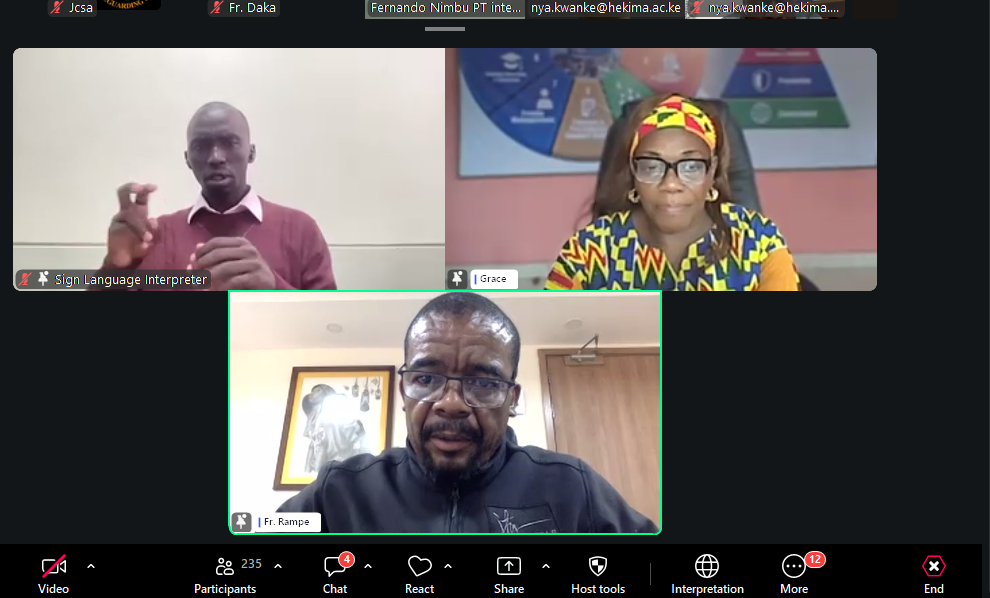
On June 16, 1976, thousands of black schoolchildren in Soweto took to the streets to protest the imposition of Afrikaans as a medium of instruction, a seemingly linguistic issue that served as the final straw for a generation oppressed by a system designed to keep them subservient. The 1976 Soweto Uprising, commemorated annually as the Day of the African Child, was not an isolated incident but a violent eruption in a long history of injustice. In commemoration of this pivotal moment, the Jesuit Centre for Safeguarding in Africa (JCSA) hosted a powerful webinar reflecting on the legacy of 1976, the apartheid-era fault lines that still shape South Africa, and their intersection with the modern imperative of safeguarding and social justice.
The event featured poignant reflections from Fr. Rampe, SJ, and Fr. Daka, SJ, who navigated the complex terrain from the Group Areas Act of 1950 to the intergenerational trauma still palpable in communities today. The webinar was not merely a history lesson but a call to action, urging all of us to recognize that the struggle for human dignity is a continuous one, requiring vigilance, courage, and a deep commitment to the principles of Catholic Social Teaching. As Fr. JB, SJ, noted in his concluding remarks, “South Africa is a flashpoint, but it doesn’t mean that other countries are free. Those fault lines exist in each and every community.”
The Architecture of Apartheid: Constructing Injustice
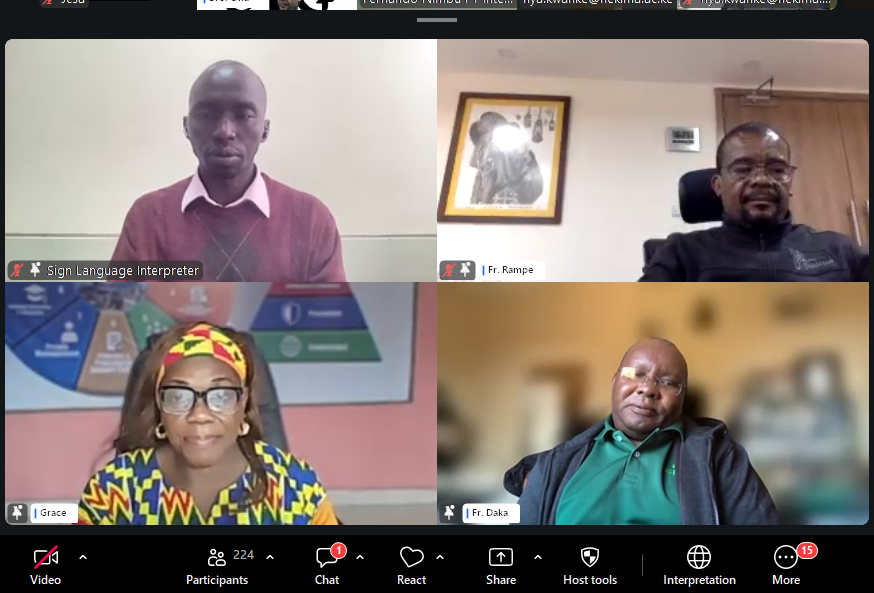
To understand the anger that fueled the Soweto Uprising, one must first understand the legal machinery that constructed and enforced racial segregation. Fr. Rampe, SJ, began the webinar by detailing the apartheid government’s legislative framework, starting with the Group Areas Act of 1950. “It was one of those cornerstone laws of apartheid that the apartheid government in South Africa used to provide a legal framework for racial and residential segregation, including forced removals of black people or people of color from certain areas,” he explained. This act categorized people into distinct racial groups: White, Black, Colored, and Indian, and designated specific urban zones for each. The government argued this would “reduce racial conflict,” but its true purpose was more insidious.
“In fact, it was to preserve white political and economic dominance,” Fr. Rampe asserted. The consequences were devastating. Vibrant, mixed communities like Sophiatown in Johannesburg and District Six in Cape Town were systematically destroyed. Millions of people were uprooted from their homes and communities where they had lived for generations and forcibly relocated to desolate townships on the periphery of the cities. Fr. Rampe vividly described this forced displacement, noting that black and colored people were moved “nearer from the cities and urban city centers and moved far away to the townships.” This physical removal had immense economic and social consequences. People were separated from their livelihoods, forced to incur high travel costs to commute into the city centers, and subjected to economic hardships and social and psychological effects.
Alongside the Group Areas Act, the Pass Laws were another pillar of oppression. These laws required Black South Africans to always carry a passbook, especially in urban areas. “The purpose was to ensure a steady supply of cheap labor for the white-owned industries and to prevent permanent black settlement in the cities,” Fr. Rampe explained. This created a climate of constant fear. He shared a personal memory of this oppression from his youth: “I remember myself when I was still young in Johannesburg and my uncles would want to go with me into town because it seemed as if whenever you travelled with a child, you were not harassed… I was like a protection means of protection, a guarantee that they will come back home that day without being harassed by the police in town.” This personal testimony highlights the dehumanizing nature of the system, which violated basic human dignity and kept families separated.
Bantu Education: Preparing a Child for Subservience
The 1976 uprisings were a direct response to the education system designed by the apartheid regime. Fr. Rampe delved into the Bantu Education Act of 1953, which aimed to take control of black education from missionary schools and ensure that it prepared black South Africans to take his menial place in society. He quoted the “architect of apartheid,” Hendrik Verwoerd, who famously argued that black South Africans should not receive an education suited for integral human development. Instead, education for a black child, was meant to prepare them to be able to take instructions from the master.
This system was characterized by chronic underfunding. Fr. Rampe pointed out the stark disparity in budgets: “I mean, in some years it could even be something between 60 or 70. Sixty 70% for the whites and then 30% for black schools.” He further detailed how this manifested in overcrowded classrooms, poor infrastructure, and a lack of learning materials. “It was not uncommon to do things like mathematics and physical sciences and chemistry without a laboratory in school.” The curriculum was stripped of subjects that might encourage critical thinking, limiting students to their mother tongue, English, and Afrikaans. “Other languages like French, Spanish, German, were not allowed because the system believed that it was not necessary for the black child to learn those,” Fr. Rampe noted, underscoring the system’s aim to limit the black child’s worldview and potential.
1976: The Straw That Broke the Camel’s Back
While the immediate trigger for the 1976 protests was the imposition of Afrikaans as a medium of instruction, Fr. Rampe was clear that this was just “the straw that broke the camel’s back.” The uprising was the culmination of decades of frustration, trauma, and resistance. He contextualised it within a broader struggle that included the women’s march against pass laws in 1956 and the Sharpeville Massacre of 1960, where 69 protestors were gunned down. “In all honesty, there were many other injustices that these students were now saying we’ve had enough of this and we need to stand up,” he stated. “It was a continuation of what blacks in general were feeling.” The 1976 protests, therefore, were not a unique event but part of a “bigger picture.”
The uprising, which began in Soweto and spread nationwide, triggered immense state brutality. “Many, many young people had to flee the country. Many were killed and many more were arrested and detained,” Fr. Rampe recounted. In his own parish, members of the youth group were arrested and detained without trial. “The church was there journeying with the young people during these difficult times as they were fighting for the dignity of the black person.”
The Three Dangers: Black, Red, and Roman Catholic
An intriguing aspect of the historical analysis was the mention of the “three dangers” that the apartheid regime often spoke of. Fr. Rampe explained: “We talk of this sort far, which is the black danger; the red danger; which was communism. And then the warm Safar, which was the Roman Catholic Church. The danger from the church.” This highlights the role of the Church as a perceived threat to the state’s ideology.
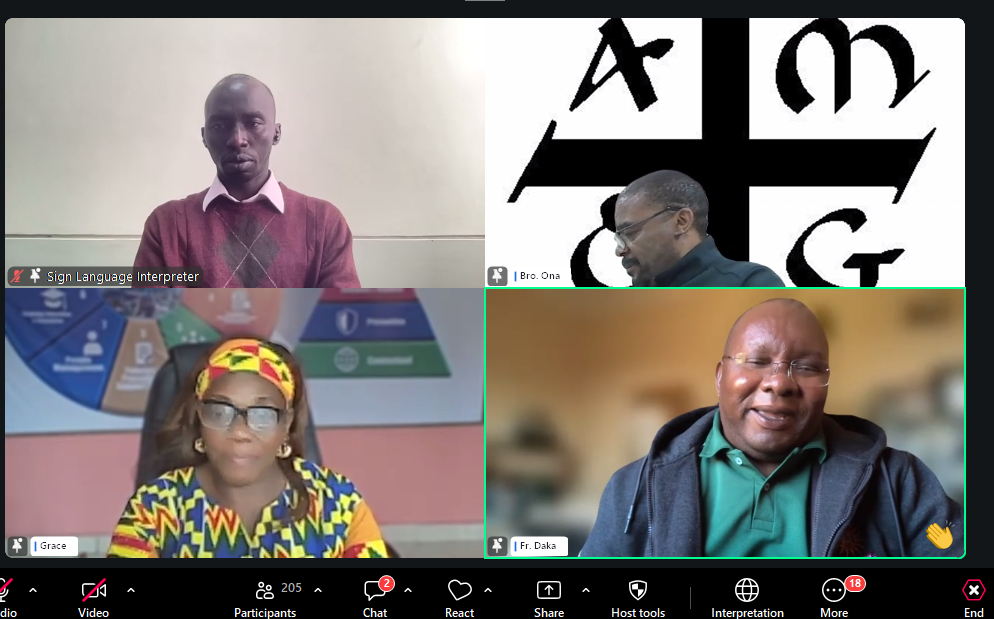
The influence of the Church was significant. The webinar featured a poster of Dom Helder Camara, a Brazilian bishop whose words resonated in South Africa: “When I give food to the poor, they call me Saint. When I asked why the poor have no food, they call me a communist.” This quote perfectly encapsulates the prophetic and uncomfortable role the Church was called to play. Fr. Rampe noted that the Church accompanied the youth, leading funeral services for victims of police brutality and providing a moral and spiritual foundation for the struggle against injustice.
50 Years On: Fault Lines Still Visible
Despite the end of apartheid and the adoption of a progressive Constitution that guarantees access to basic education, Fr. Rampe argued that “the fault lines are still there, Quite obvious.” The struggle today is not for access to any education, but for access to “good quality education.” He lamented that while many can access education, it remains “a privilege left for the few or those who can afford.” The gap between the rich and the poor is not shrinking; it is “getting bigger.” Education, instead of being a great equaliser, often reinforces inequality. He questioned the purpose of the current education system: “Are we forming men and women for others who will transform the world into a more just and humane, exclusive and sustainable place for all? Or it’s just formation for just the privileged few?” This echoes the core principles of Catholic Social Teaching, which advocates for integral human development.
Safeguarding as a Culture, Not a Tick-Box
The conversation naturally flowed into the topic of safeguarding, highlighting the critical role of the Church in healing trauma and preventing future abuse. Fr. Daka, SJ, addressed the challenge of moving safeguarding from a “tick box exercise” to a genuine culture: “We need to talk about these problems until we have developed a culture that embraces safeguarding, as something that becomes part of us and a way of life.” He stressed that safeguarding should be understood as creating a “culture of Wellness for all, especially the vulnerable,” rather than merely a reaction to scandals.
Fr. Daka also emphasised the importance of Catholic Social Teaching in this process. He argued that the principles of “participation on solidarity, the common good, human dignity, and preferential option for the poor” should be integral to catechesis and parish life. Unfortunately, he lamented that Catholic Social Teaching remains “the best kept secret” in many parishes. “Many parish priests, they don’t make sure that your ordinary Catholic or Christian know about these things and what the church is saying.” This disconnect means that many Catholic politicians and laypeople are not inspired by these values to work for justice. This sentiment was echoed by a participant, Miss Ansel, who expressed concern that many people in ordinary Catholic life know very little about the Church’s social teachings. Fr. Rampe agreed, calling for these teachings to be an “integral part of the syllabus” for confirmation and other catechetical classes.
A Question of Secondary Trauma and Xenophobia
A poignant moment in the webinar was a discussion on what Fr. Daka, SJ, termed “secondary trauma.” He observed that while the generation that suffered directly under apartheid often displays remarkable peace and resilience, it is “the children; the younger people” who are now perpetuating injustice and violence, particularly in the form of xenophobic attacks. Fr. Daka suggested that this aggression might be a manifestation of unaddressed wounds passed down from their parents. He raised the example of the recent wave of anti-immigrant sentiment in South Africa, noting that it is often the younger people who are calling for these other Africans to leave.
Fr. Rampe responded by adding another layer of complexity. He noted that violence has been a recurring factor in South Africa, affecting not just the youth of 1976 but also those in the 1980s and 1990s. He shared that he grew up witnessing killings and burnings, a reality that has left many traumatised. He concluded: “We grew up with that violence. So what you see now, maybe it’s something that has been recurring over the years and maybe we need counselling as a nation. All of us.”
Fr. Rampe expanded on the issue of xenophobia, urging against a simplistic approach. He argued that the problem is complex and rooted in a mix of factors, including the government’s failure to deliver on its promises of a new dawn, high unemployment, and the scapegoating of foreign nationals. He noted that while the government has made huge improvements, a huge gap remains. He challenged the continent to reflect on the push and pull factors of migration, asking, “What is it that we as a continent, as young people, what is it that we’re doing to hold our governments accountable?” He stressed that solving the problem requires addressing issues of good governance, corruption, and economic injustice at their source.
The Role of the Church: From the Family to the Global Community
Melanie, a participant from Nairobi, Kenya, brought the discussion back to the foundational unit of society; the family. She argued that a lot of negativities that we are having in institutions or in nations across Africa, a lot of it comes from our homes. She noted that perpetrators of violence like xenophobia may be acting out of personal wounds and family dysfunction. Her plea to the church was to develop tailored solutions for the basic unit of society; a lot of disagreements that you see people channeling through xenophobia, are mostly from our own pains and angers that we source from our families. She called for safe spaces for family counselling and a strong emphasis on family values, as the Church remains the most trusted institution in Africa. “If the rot starts from there, it does not matter just how much we safeguard vulnerabilities,” she warned.
Fr. Rampe challenged participants to volunteer their professional skills to help parishes respond to the psychosocial needs of their communities. He lamented that many qualified professionals don’t come forward to volunteer their skills for the parish to help the parish priests. He stressed that the parish is the geographical area where the church finds itself, meaning its mission is to respond to the needs of everyone in the community, not just the Catholic faithful.
The JCSA’s Call to Action
Fr. Daka, SJ, concluded by reiterating the vision of the JCSA. He argued that safeguarding is the responsibility of everyone and that the Church has a crucial role to play in creating a consistent culture of safeguarding. He tied this directly to the themes discussed throughout the webinar, stating that safeguarding is not merely about preventing abuse but about restoring human dignity and building peace. “Human life deserves a great dignity and that dignity must not be violated,” he asserted. “By protecting that human dignity, you are actually doing safeguarding work.”
The webinar ended with a powerful call for active participation. Fr. JB, SJ, in his concluding remarks, noted that these challenges are societal. They are not going to go away. So, it our responsibility as a community to continue to educate and to build those structures of awareness that help to reduce the challenges we are facing. He called for appreciative engagement, where communities identify what is already working to build safety and expand upon it. This, he argued, is how lasting impact is made. In his final words, he captured the ethos of the entire discussion: “When you ask the questions, you are already beginning to find the solutions.”
The legacy of 1976 and the persistent challenges of inequality, trauma, and injustice serve as a stark reminder that the work of building a just and peaceful society is never truly done. As we reflect on the courage of the youth who stood up for their dignity, we are called to continue their struggle in our own time, safeguarding the vulnerable and healing the wounds of the past to create a future where every person is treated with the dignity they deserve as a child of God.

Thanks for adding me.